Beijing Airport Arrival Guide: Your First Hour in China (Step by Step)
From landing to your hotel: immigration, customs, SIM cards, transport to city center, and everything you need for a smooth arrival at Beijing Capital or Daxing Airport.
So You're About to Land in Beijing β Here's Exactly What to Expect
Your first hour in China can be a little overwhelming if you don't know what's coming. Different language, different systems, different everything. But here's the thing: once you know the steps, it's actually pretty straightforward. I've helped hundreds of first-time visitors navigate Beijing's airports, and I'm going to walk you through it exactly the way I'd walk a friend through it β step by step, no surprises.
Take a deep breath. You're going to be fine. Let's go through everything from what to do on the plane to what to do once you're settled in your hotel room.
Before You Land: What to Do on the Plane
About an hour before landing, the flight crew will hand out two forms. Don't ignore them β filling these out on the plane saves you a bunch of time on the ground.
Arrival Card (Entry/Exit Form)
This is a small card you'll need to present at immigration. You'll fill in:
- Full name (exactly as it appears on your passport)
- Passport number
- Nationality
- Visa number (check the sticker in your passport β or if you're entering visa-free under the 144-hour transit policy, write "144-hour transit")
- Flight number (it's on your boarding pass)
- Purpose of visit (usually "Tourism" or "Sightseeing")
- Address in China (your hotel name and address β have this written down beforehand!)
Pro tip: Take a photo of your hotel booking confirmation before you board. You'll need the address in Chinese characters for this form and for the taxi later. If you don't have it, use the English name β immigration officers will understand.
Customs Declaration Form
This one is simpler. Most tourists tick "No" to everything. You'll need to declare if you're carrying:
- More than $5,000 USD (or equivalent) in cash
- Animals, plants, or biological materials
- Radio equipment or controlled items
- Commercial goods or samples exceeding duty-free limits
If you're a regular tourist with normal luggage, you'll breeze through this. Just be honest β the consequences of not declaring are far worse than the minor hassle of declaring.
Beijing's Two Airports: Which One Are You Landing At?
Beijing has two major international airports, and your experience will differ depending on which one you're flying into. Check your ticket carefully β it matters for planning your city transfer.
Beijing Capital International Airport (PEK)
This is the older, more established airport, located about 25 km northeast of the city center. It opened in 1958 and has been expanded several times. Most international flights still arrive here.
Three terminals:
- Terminal 1: Hainan Airlines and a few smaller domestic carriers
- Terminal 2: China Southern, China Eastern, and most SkyTeam alliance airlines (Delta, Korean Air, etc.)
- Terminal 3: The big one. Air China (Star Alliance hub), United, Lufthansa, ANA, Cathay Pacific, British Airways, Emirates, and most other international carriers. This is probably where you'll land.
Terminal 3 is massive β it was designed by Norman Foster and was the largest airport terminal in the world when it opened. If you're arriving here, be prepared for some walking. The automated people-mover train between sections of T3 takes about 2 minutes and runs constantly.
Beijing Daxing International Airport (PKX)
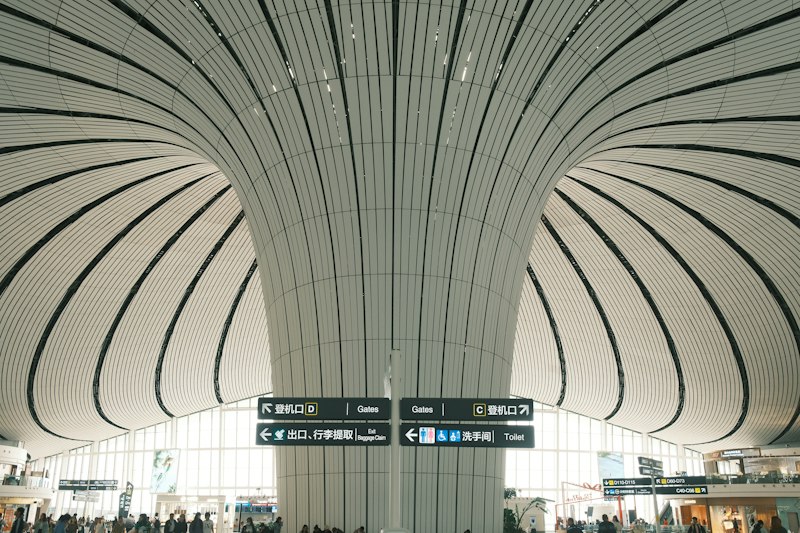
The new kid on the block. Daxing opened in September 2019 and is located about 46 km south of the city center. It was designed by Zaha Hadid and the building itself is genuinely stunning β shaped like a giant starfish with a futuristic interior.
Airlines at Daxing:
- China Southern Airlines (major hub here)
- China Eastern Airlines
- China United Airlines
- Several international carriers: British Airways, Finnair, LOT Polish, some routes from Turkish Airlines, and others
Daxing is newer and less chaotic than Capital Airport's T3 during peak hours. However, it's further from the traditional tourist areas in central and northern Beijing. If you're staying near Tiananmen, the Forbidden City, or the hutong neighborhoods, Capital Airport (PEK) is more convenient.
Quick rule of thumb: If you're flying a Star Alliance carrier (United, Lufthansa, Air China), you're almost certainly landing at PEK Terminal 3. If you're on China Southern or a SkyTeam carrier, check carefully β some routes have moved to Daxing.
Step-by-Step After Landing at Capital Airport (PEK)
Alright, the wheels have touched down. Here's exactly what happens next, in order.
Step 1: Deplane and Follow the Signs
Follow the signs that say "Arrivals" or "Immigration" (ε ₯ε’ζ£ζ₯). In Terminal 3, you may need to take the automated people-mover train from the satellite building to the main terminal. Just follow the crowd β everyone's going the same way. The signs are in both Chinese and English throughout the airport.
Step 2: Immigration (Passport Control)
This is the part people worry about most, but it's really not bad. Here's what to expect:
Which line to join: Look for the signs that say "Foreigners" (ε€ε½δΊΊ). Do NOT accidentally join the Chinese Citizens line β it happens more often than you'd think, and you'll just have to walk back.
Wait time: Expect anywhere from 10 minutes to 45 minutes depending on how many flights have landed at the same time. Early morning arrivals from the US and Europe tend to create the longest lines because several flights land close together.
What the immigration officer will ask or check:
- Your passport and arrival card (the one you filled out on the plane)
- Your visa (or the documentation for visa-free transit)
- Purpose of visit β just say "Tourism" or "Vacation"
- Where you're staying β name your hotel
- How long you're staying β give your departure date
- Return/onward ticket β they occasionally ask to see this, especially for 144-hour transit entries
Fingerprint scan: This is standard procedure for all foreign visitors aged 14-70. You'll place both index fingers on a scanner at the immigration counter. It takes about 5 seconds. Nothing to worry about β it's fully routine.
Photo capture: A camera at the counter will automatically take your photo. Just look straight ahead when prompted.
Once approved, the officer will stamp your passport and hand it back. Done. You're officially in China.
Step 3: Baggage Claim
Follow the signs to "Baggage Claim" (θ‘ζζε). Check the display screens for your flight number and corresponding carousel number.
Tips:
- Immigration can take a while, so your bags might already be waiting by the time you get there. Check the side area where unclaimed bags are sometimes lined up off the carousel.
- If your bag is missing or damaged, find the airline baggage service counter in the baggage claim area before you exit. Once you leave, it's much harder to file a claim.
- Grab a free luggage cart β they're available throughout the baggage hall.
Step 4: Customs
After collecting your bags, you'll walk through customs. There are two channels:
- Green Channel (ζ η³ζ₯ιι): Nothing to declare. This is what 95% of tourists use. You walk straight through. Occasionally an officer might randomly stop you for a bag scan, but this is rare.
- Red Channel (η³ζ₯ιι): If you have items to declare (large amounts of cash, commercial goods, etc.), use this channel. You'll fill out a declaration form and your bags will be inspected.
If you're a normal tourist with clothes, electronics for personal use, and gifts worth less than 5,000 RMB, walk through the green channel without hesitation.
Step 5: You're in the Arrivals Hall!
Welcome to Beijing. You'll emerge into the arrivals hall where you'll find currency exchange, SIM card counters, and transportation options. Take a moment to breathe β the hardest part is over.
Step-by-Step After Landing at Daxing Airport (PKX)
The process at Daxing is essentially the same as at Capital Airport, but the building is newer, more intuitive, and generally less crowded for international arrivals.
Key Differences at Daxing
- Single terminal: Daxing has one unified terminal (no confusing T1/T2/T3 situation). Everything flows in one direction. Follow the signs downward β international arrivals go through a clearly marked path.
- Immigration: Same process β foreigner line, fingerprints, passport stamp. Daxing tends to have shorter wait times because it handles fewer international flights.
- Layout: The building is designed like a five-pointed star with a central hub. It sounds confusing but it's actually very intuitive once you're inside. Walking distances feel shorter than Capital T3.
- Customs: Same green/red channel system. Most tourists go straight through green.
- Arrivals hall: Modern, spacious, with SIM card counters, currency exchange, and clear signage for transportation. Daxing's transportation hub is directly below the terminal β just take the escalators down.
One thing to note: Daxing is further from the traditional tourist center of Beijing. If your hotel is near the Forbidden City, Wangfujing, or the hutong areas, budget extra time and cost for the transfer compared to Capital Airport.
Getting a SIM Card or eSIM: Your First Priority
I cannot stress this enough: you need mobile data the moment you leave the airport. Here's why:
- Google Maps doesn't work in China. You need Baidu Maps or Amap, and they need data.
- You'll need a translation app constantly for the first few days.
- Taxi drivers communicate via phone. Didi (China's Uber) requires data.
- WeChat and Alipay β the payment apps you'll use everywhere β need internet.
Option 1: Airport SIM Card Counters (Buy on Arrival)
Both airports have official China Mobile and China Unicom counters in the arrivals hall. Look for the bright branded kiosks right after you exit customs.
- China Mobile: The biggest carrier with the best coverage. A tourist SIM with 20GB of data valid for 30 days typically costs around 200-300 RMB (about $28-42 USD). They also have 7-day and 14-day options.
- China Unicom: Slightly cheaper, with comparable coverage in Beijing. They offer similar tourist packages.
You'll need your passport to register the SIM card (it's a legal requirement in China). The staff at the airport counters speak basic English and can help you set it up. The whole process takes about 10-15 minutes.
Option 2: eSIM (Set Up BEFORE You Leave Home)
This is my preferred recommendation if your phone supports eSIM. Set it up at home before your trip and it'll activate the moment you land.
- Airalo: The most popular option for China. Buy a China data plan through their app or website. Plans start around $5 for 1GB/7 days. I recommend at least 5GB for a week-long trip. Install the eSIM profile before you leave home, and toggle it on when you land.
- Nomad eSIM, Holafly, or Ubigi: Other solid options with China coverage. Compare prices and data amounts.
Important note about eSIMs and VPNs: Many eSIM providers for China route your data through servers that bypass the Great Firewall, meaning you might be able to access Google, Instagram, and WhatsApp without a VPN. This varies by provider and isn't guaranteed, so don't count on it. Always have a VPN as a backup.
Option 3: Pocket WiFi
You can rent a portable WiFi device at the airport or pre-order one for pickup. These are good for groups since multiple people can connect. Expect to pay around 30-50 RMB per day. However, they're one more device to charge and carry, so I personally prefer a SIM or eSIM.
Getting to City Center from Capital Airport (PEK)
You've got your bags, your SIM card is working, and you're ready to get to your hotel. Here are your options, ranked by my recommendation.
Airport Express Train (Best Value)
The Airport Express is a dedicated metro line connecting Capital Airport to the city subway system.
- Fare: 25 RMB (about $3.50 USD) β yes, really
- Route: Terminal 3 → Terminal 2 → Sanyuanqiao Station (Line 10) → Dongzhimen Station (Lines 2 and 13)
- Travel time: About 25 minutes to Dongzhimen
- Hours: Roughly 6:20 AM to 10:50 PM (check current timetable as it updates seasonally)
- Frequency: Every 10 minutes during peak hours
At Dongzhimen or Sanyuanqiao, you can transfer to the regular Beijing subway to reach most hotels. The entire subway system costs 3-7 RMB per ride depending on distance.
How to ride it: Follow the signs to "Airport Express" in the arrivals area. You can buy a single-journey ticket from the machines (cash or Alipay/WeChat Pay) or tap with a Beijing Transportation Card. The machines have an English language option.
This is my top recommendation for solo travelers and couples. It's cheap, fast, and avoids Beijing traffic entirely.
Taxi (Most Convenient)
If you have a lot of luggage or just want door-to-door service, a taxi is the way to go.
- Cost: 80-120 RMB ($11-17 USD) to central Beijing, depending on exactly where you're going and traffic
- Travel time: 40-90 minutes depending on traffic (Beijing traffic can be brutal, especially during rush hours 7-9 AM and 5-8 PM)
- How to get one: Follow the "Taxi" signs to the official taxi queue outside the arrivals hall. There's always a line of taxis waiting. Join the queue and a dispatcher will assign you to the next available cab.
Critical tips for taxis:
- Always use the meter. Legitimate taxis start the meter automatically. The base fare is 13 RMB for the first 3 km, then about 2.3 RMB per km after that, plus a fuel surcharge.
- Never accept rides from people approaching you inside the terminal. These are unlicensed drivers who will overcharge you. Always go to the official taxi queue outside.
- Show the driver your hotel address in Chinese characters. Have it on your phone screen. Most taxi drivers don't speak English, so written Chinese is essential.
- Keep the receipt. It has the taxi number on it, which you'll need if you forget something in the cab.
- Payment: Taxis accept cash (RMB only), and most now accept Alipay or WeChat Pay as well. Have some cash ready just in case.
Private Transfer (Most Comfortable)
If you want someone holding a sign with your name, a clean car, and zero stress, book a private transfer in advance.
- Cost: 300-500 RMB ($42-70 USD) for a standard sedan; more for a larger vehicle
- How: Book through your hotel, a tour company (like us!), or platforms like Klook or GetYourGuide
- Perks: The driver will meet you in the arrivals hall, help with luggage, and drive you directly to your hotel. Many drivers speak basic English. Some services include a welcome kit with a local SIM card, water, and a city map.
I especially recommend this for families, first-time China visitors arriving on a late-night flight, or anyone who just wants to eliminate all stress after a long-haul flight.
Airport Bus (Cheapest Option)
Several airport bus routes connect Capital Airport to different parts of the city.
- Cost: 16-30 RMB ($2-4 USD) depending on the route
- Routes: Multiple lines going to Xidan, Beijing Railway Station, Gongzhufen, Zhongguancun, and other major areas
- Hours: Some routes run 24 hours (the night bus to Xidan is a lifesaver for late arrivals)
- Travel time: 60-90 minutes depending on route and traffic
Honestly, I only recommend the bus for budget travelers or those arriving very late when the Airport Express has stopped running. The signage at the bus stops is mostly in Chinese, and announcing stops can be confusing for first-timers. If you do take the bus, have your destination written in Chinese and ask the driver to let you know when to get off.
Getting to City Center from Daxing Airport (PKX)
Daxing's transportation hub is conveniently located directly below the terminal building. Take the escalators down and you'll find all your options.
Daxing Airport Express (Subway Line 19 South Section)
This is the fastest way into the city from Daxing.
- Fare: 35 RMB ($5 USD) to Caoqiao Station, which connects to Line 10 (the main circle line)
- Travel time: About 19 minutes to Caoqiao β it's fast
- Hours: Roughly 6:30 AM to 10:30 PM
- Key stops: Daxing Airport → Daxing Xincheng → Caoqiao (transfer to Line 10)
From Caoqiao, transfer to Line 10 and then connect to whichever line takes you to your hotel. The whole journey to central Beijing (say, Wangfujing or Tiananmen area) takes about 50-60 minutes total including the transfer.
Taxi from Daxing
- Cost: 150-200 RMB ($21-28 USD) to central Beijing β more expensive than from Capital Airport because of the greater distance
- Travel time: 50-80 minutes depending on traffic
- Same rules apply: Use the official taxi queue, insist on the meter, have your hotel address in Chinese
Didi (China's Uber)
If you've already set up the Didi app (more on that below), you can order a car directly. Didi now has an English-language version of the app and accepts international credit cards.
- Cost: Similar to or slightly less than a taxi, around 130-180 RMB to central Beijing
- Benefit: You enter your destination in the app, so there's no language barrier with the driver. You can also see the fare estimate in advance.
- Pickup: Follow the signs to the ride-hailing pickup area at the airport. The app will show you exactly where to wait.
Intercity Bus and High-Speed Rail
Daxing also connects to the high-speed rail network via Daxing Airport Railway Station, which is handy if you're heading to Tianjin or other cities. For getting to central Beijing, stick with the subway or a car.
First Things to Do After Arriving at Your Hotel
You've made it to your hotel. Drop those bags, sit on the bed for a moment, and then take care of these important items before you crash for the night.
Police Registration (Hotels Handle This)
By Chinese law, all foreign visitors must register with local police within 24 hours of arrival. The good news: hotels do this automatically when you check in. They'll scan your passport and submit the registration. You don't need to do anything extra. Just make sure you have your passport when checking in.
If you're staying at an Airbnb or with friends, your host is responsible for taking you to the nearest police station to register. This is non-negotiable β don't skip it.
Connect to WiFi and Test Your VPN
Your hotel will have WiFi. Connect and immediately test your VPN. In China, the following services are blocked without a VPN:
- Google (all services: Search, Gmail, Maps, YouTube)
- Facebook, Instagram, Twitter/X
- WhatsApp, Telegram
- Many Western news websites
If your VPN works, great. If it doesn't, try different servers or protocols. This is why I recommend setting up multiple VPN options before you leave home (more on that below).
Set Up Alipay
Alipay is one of China's two dominant mobile payment platforms, and it now works for international visitors. You can link an international Visa or Mastercard and use it to pay at shops, restaurants, subway stations, and street vendors. Seriously β many places in Beijing no longer accept cash easily.
Open Alipay, follow the international user setup, link your card, and load some funds into your account. Test it by buying a water bottle at the hotel shop.
Download Essential Apps
If you didn't download these before your trip (you should have β see below), do it now over the hotel WiFi:
- Didi: For booking taxis and ride-hailing
- Baidu Maps or Amap (Gaode): For navigation β Google Maps is unreliable in China
- WeChat: China's everything app. Messaging, payments, and social media.
- Google Translate: Download the Chinese language pack for offline translation and the camera feature (point your phone at Chinese text and see it translated in real time)
Essential Apps to Download BEFORE Your Trip
This is the section I wish someone had told me before my first time in China. Download and set up all of these before you leave home, because some of them are difficult or impossible to install once you're inside the Great Firewall.
1. A Reliable VPN (Critical β Download at Home)
This is your number one priority. Without a VPN, you can't access Google, social media, WhatsApp, or most Western websites. Popular options that work well in China:
- ExpressVPN: Widely considered the most reliable for China. Not cheap, but it works when others don't.
- Astrill: Very popular among expats living in China. Excellent performance.
- NordVPN or Surfshark: More affordable alternatives. They work, but sometimes connections are spotty.
You MUST download and install your VPN before entering China. VPN websites are blocked in China, so you won't be able to download one once you arrive. Install the app, log in, test it, and make sure it works. Consider setting up two different VPN services as a backup.
2. Alipay
Download and create your account at home. You can link your international credit or debit card and be ready to make payments from day one. Alipay has rolled out a "Tour Pass" feature specifically for international visitors. This is the app you'll use most often in Beijing β from paying for meals to buying subway tickets.
3. WeChat
WeChat is the Swiss Army knife of Chinese apps. Everyone in China uses it. You can message people, make payments (via WeChat Pay β also accepts international cards now), scan QR codes, and more. Many hotels, restaurants, and tour operators communicate exclusively through WeChat. Create your account and add WeChat Pay before you arrive.
4. Didi (Chinese Uber)
Didi is how you'll get around when the subway isn't convenient. The app now has a full English interface and accepts international credit cards. Set it up at home, add your payment method, and you'll be able to hail rides the moment you land. It's reliable, cheap, and eliminates the language barrier with drivers since you enter your destination in the app.
5. Baidu Maps or Amap (Gaode Maps)
Let me be blunt: Google Maps does not work properly in China. It loads slowly (if at all), the data is inaccurate, and it can't provide transit directions. You need a Chinese mapping app:
- Baidu Maps: Has an English interface option (though it's imperfect). Best for searching in English.
- Amap (Gaode): More accurate for real-time transit and traffic data. Interface is mostly Chinese, but it works with English searches.
Download at least one of these. I recommend Baidu Maps for most foreign visitors because the English support is better.
6. Google Translate (with Offline Chinese Pack)
Google Translate is still the best translation tool for tourists, but you need to prepare it properly:
- Download the app before your trip
- Go to Settings → Offline Translation and download the Chinese (Simplified) language pack
- This lets you translate text even without internet (and remember, Google services need a VPN in China)
- The camera feature is incredible β point your phone at a Chinese menu, street sign, or document and see it translated in real time on your screen
7. Pleco (Chinese Dictionary)
Pleco is the gold standard Chinese dictionary app. It's free and works offline. Beyond just looking up words, it has:
- Optical character recognition (point your camera at Chinese text)
- Handwriting recognition (draw a character you see and it'll identify it)
- Flashcards for learning basic phrases
- Audio pronunciation for every word
Even if you don't plan to learn Chinese, Pleco is invaluable for figuring out what things are. See a sign you can't read? Point Pleco's camera at it. Done.
8. Bonus Apps Worth Having
- Trip.com (Ctrip): China's biggest travel booking platform. Great for booking trains, domestic flights, and hotels at local prices.
- Metro Man: An excellent English-language subway map app for Beijing (and other Chinese cities). Works offline.
- Microsoft Translator: A good backup to Google Translate, and it works without a VPN.
Your Pre-Landing Checklist
Here's a quick summary you can screenshot and reference on the plane:
| Task | When | Status |
|---|---|---|
| VPN downloaded and tested | Before trip | |
| Alipay account created, card linked | Before trip | |
| WeChat installed, account created | Before trip | |
| Didi app installed, payment added | Before trip | |
| Baidu Maps downloaded | Before trip | |
| Google Translate + Chinese offline pack | Before trip | |
| Pleco dictionary downloaded | Before trip | |
| eSIM purchased and installed | Before trip | |
| Hotel address saved (in Chinese characters) | Before trip | |
| Arrival card filled out | On the plane | |
| Customs form filled out | On the plane | |
| SIM card activated / eSIM toggled on | After landing |
Common Mistakes First-Timers Make at Beijing Airport
I've seen all of these. Learn from other travelers' mistakes:
- Not having the hotel address in Chinese. This causes more stress than anything else. Taxi drivers don't read English addresses. Save it in Chinese on your phone.
- Joining the wrong immigration line. The "Chinese Citizens" line moves fast and it's tempting, but you'll be sent to the back of the Foreigners line. Look for the signs carefully.
- Not having cash. While mobile payment is king in Beijing, having 500-1,000 RMB in cash is smart for your first day. Some taxis, small vendors, and tips are easier with cash. Exchange at the airport or withdraw from an ATM (there are ATMs in the arrivals hall that accept international cards).
- Forgetting to download a VPN before arriving. I'll say it again because it's that important. Once you're in China, you cannot download a VPN. Do it at home.
- Taking an unlicensed taxi. Guys in the terminal will approach you offering rides. They charge 3-5x the normal fare. Always use the official taxi line outside.
- Panicking about the language barrier. Beijing's airports have excellent English signage and immigration officers speak basic English. You'll be fine. Just stay calm and follow the flow.
What If Your Flight Arrives Late at Night?
If you land after 11 PM, your options narrow but you're not stranded:
- Airport Express (PEK): Last train is around 10:50 PM. If you miss it, this isn't an option.
- Taxis: Available 24/7 at both airports. The queue is shorter at night, so you'll get one quickly. Expect to pay a late-night surcharge (20% more after 11 PM).
- Airport bus: Capital Airport has some routes that run until midnight or all night. The night bus to Xidan is the most useful for tourists.
- Didi: Works 24/7, though fewer drivers are available late at night. Surge pricing may apply.
- Airport hotel: Both airports have hotels within walking distance or connected via shuttle. If you're arriving after midnight and don't want the hassle, consider booking a night near the airport and heading into the city the next morning when you're fresh.
You've Got This
Look, I know this article is long and the list of things to prepare might seem overwhelming. But here's the truth: thousands of foreign tourists arrive in Beijing every single day and figure it out just fine. The airports are well-organized, the transportation is world-class, and Chinese people are genuinely helpful to lost-looking foreigners (even if there's a language barrier, they'll pull out their phones to translate).
The key is preparation. Download your apps, get your VPN, set up your eSIM, save your hotel address in Chinese, and fill out your forms on the plane. Do those things and your first hour in China will be smooth, stress-free, and maybe even exciting.
Welcome to Beijing. You're going to love it here.
Planning Your China Trip?
Check out our complete step-by-step guide covering everything from visa to departure.
View Travel Guides